What is documented here
Wirken runs on commodity hardware. The three configurations below are reference builds for operators who want a hardware-side answer to "what should I run wirken on?" None is a product line. All three are parts lists. You or your supplier can buy the same parts and build the same machine.
Spule
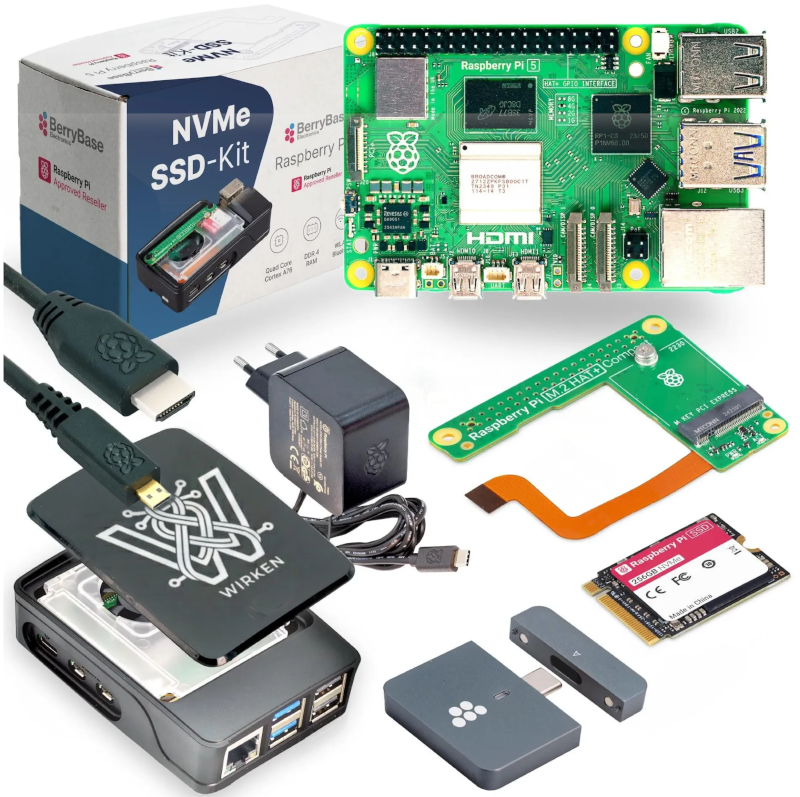
Spule is wirken on a Raspberry Pi 5: switchboard, adapters, audit log, and WebChat on the local box, LLM over TLS, no inference weights held locally. Wirken is a single static binary linked against musl, and the aarch64 build installs from the same one-line installer with no runtime underneath it. The Cortex-A76 includes the ARMv8 cryptography extensions, so SHA-256 hashing for the audit chain uses hardware instructions. Spule has less capacity than Fern for concurrent channels and retained history.
| System | Raspberry Pi 5, 8 GB |
| CPU | Quad-core Cortex-A76, 2.4 GHz |
| RAM | 8 GB LPDDR4X-4267 |
| Storage | 256 GB NVMe, M.2 2230 on M.2 HAT+ |
| Network | Gigabit Ethernet, Wi-Fi 5 |
| Power | 27 W USB-C |
| Cooling | Official active case, PWM fan |
These parts ship as a single kit, the BerryBase Raspberry Pi 5 NVMe Starterkit, at about €229.
Fern
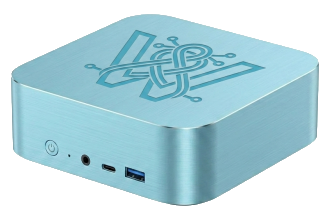
Fern hosts the switchboard, the adapters, the audit log, and the WebChat surface, and reaches the LLM over TLS. The local box never holds inference weights. Fern fits the confidential-inference posture cleanly: the only outbound inference connection is an attested HTTPS path, which can be pinned at the network layer.
| System | Beelink SER10 MAX |
| CPU | Ryzen AI 9 HX 470 |
| GPU | Radeon 890M integrated |
| RAM | 32 GB DDR5-5600 |
| Storage | 1 TB NVMe |
| Network | 10 GbE, Wi-Fi 6 |
Heim
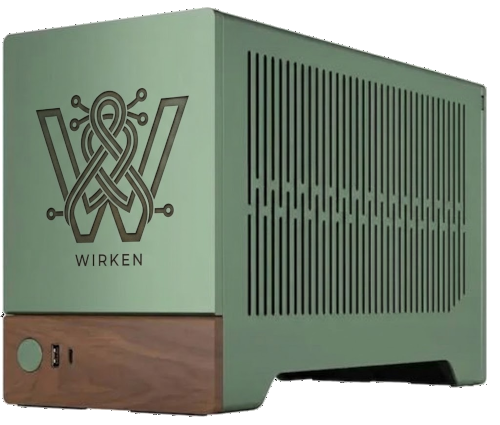
Heim is the aggregation box. It runs inference on the machine itself: embedding generation and the librarian side of Zirkel, wirken's research aggregator, and the scoring passes of Lyrik, the static-analysis skill. There is no outbound LLM connection.
| Case | Fractal Design Terra |
| CPU | Ryzen 9 9900X |
| CPU Cooler | 70mm low-profile AM5, 120mm fan |
| Motherboard | AM5 Mini-ITX, B650E, Wi-Fi 6E |
| RAM | 64 GB DDR5-6000 (2× 32 GB) |
| Storage | 4 TB NVMe PCIe 4.0+ |
| GPU | NVIDIA RTX Pro 4500 Blackwell 32 GB ECC GDDR7 |
| PSU | 850W SFX-L Platinum |
How to use this page
These are bills of materials. Source the parts and build the box, or hand the list to an integrator who will. The wirken binary does not know the difference between a reference build and a comparable machine you assembled yourself; it asks the OS for a vault key, a Unix domain socket, and a network interface, and Spule, Fern, and Heim all provide those the same way as any other Linux or macOS host. If you have a stricter security target than these references aim at, the components that matter to a wirken deployment are the same components a hardened workstation already gets right: full-disk encryption, a real TPM, secure boot, and an OS keychain you trust to hold the vault key.